
Agent Builder
Create agents with Skills and manage how they behave, so teams can tailor agents to specific tasks instead of using a fixed chatbot setup.

LobeHub is an agent collaboration platform for work and productivity. It supports multi-agent workflows, persistent memory, and cloud-based model usage across web, desktop, mobile, and CLI surfaces.
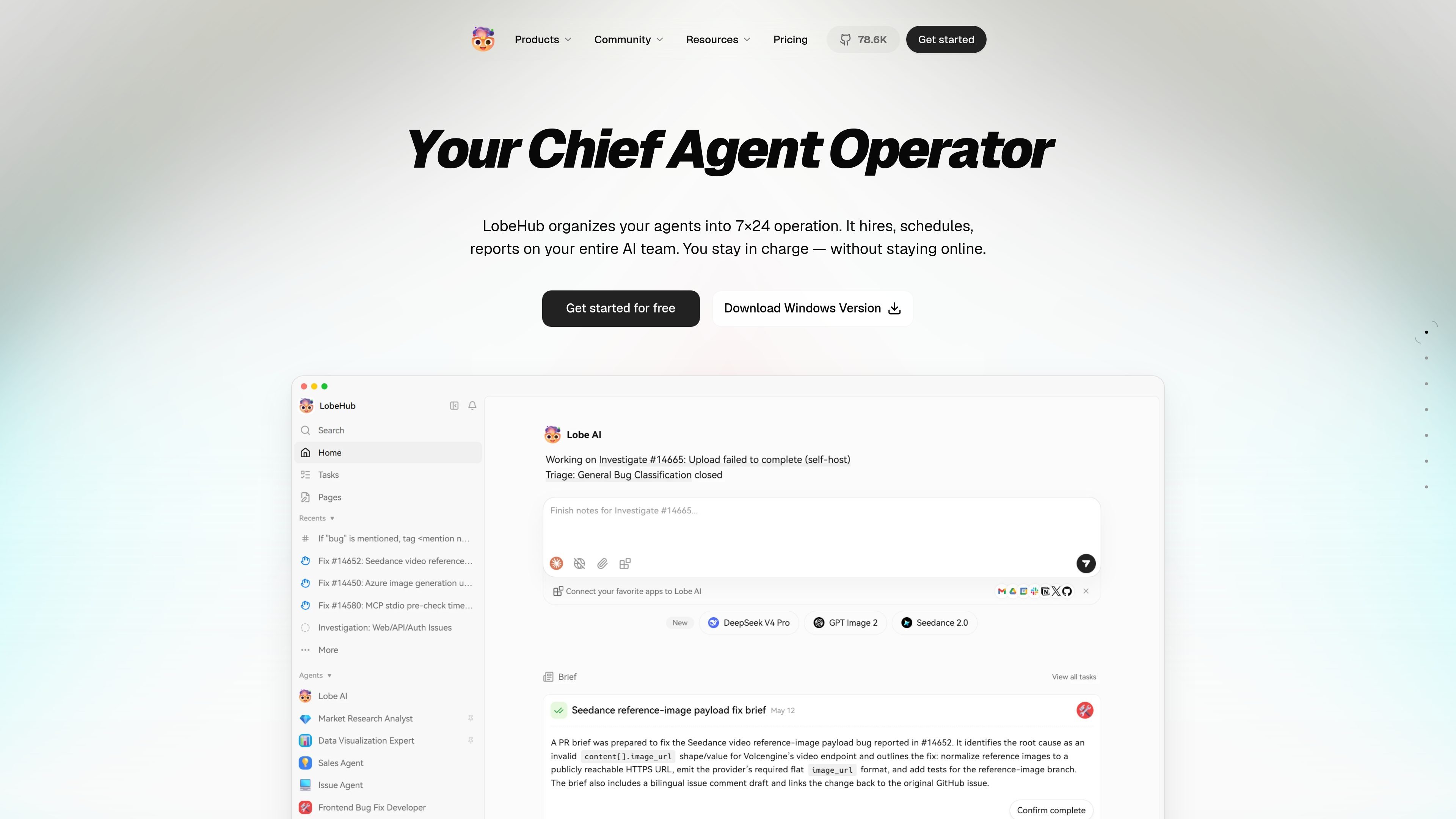
LobeHub is an agent collaboration platform for work and productivity. It is built around long-running agent teammates, shared context, and multi-agent workflows that help people move from ideation to execution without treating every request as a one-off task.
The site positions LobeHub as a place to create agents, collaborate with them in teams, and let them retain persistent memory over time. It also offers a web app, desktop app, mobile app, a CLI, and LobeHub Cloud pricing for model usage and cloud features.
Create agents with Skills and manage how they behave, so teams can tailor agents to specific tasks instead of using a fixed chatbot setup.
Assemble multiple agents for one task, with auto team formation, parallel collaboration, multi-task execution, and iterative improvement.
Work across Pages, Schedule, Project, and Workspace views to keep agent-driven work organized and shared across context.
Store persistent, editable memory for agents so they can retain context and adapt over time instead of starting from scratch each session.
Support multiple model providers and model types, with pricing coverage for text, voice, and image generation in LobeHub Cloud.
Discover and reuse community agents, MCP servers, and Skills through the marketplace and docs-linked integration surface.
Use LobeHub to draft, refine, and iterate on longer pieces of work with agents that keep context and can be revisited later.
Use agent groups to split complex work across multiple agents, then let them collaborate in parallel instead of handling each step manually.
Use Pages, Projects, and Workspaces to keep agent-assisted work organized when several tasks or stakeholders need shared visibility.
Use the marketplace and Skills to start from existing agent patterns, then adapt them to a team’s preferred way of working.
Use the cloud pricing model to estimate model usage for text, voice, or image tasks before scaling a workflow.
LobeHub is an agent collaboration platform for work and productivity. It combines Agent Builder, an Agent Marketplace, shared workspaces, and persistent agent memory for long-running tasks and team workflows.
The source highlights the Web App, Desktop App, and Mobile App as core platform options. LobeHub also offers a CLI called `lh` through the `@lobehub/cli` package.
LobeHub supports multi-model orchestration and a broad model pricing catalog in LobeHub Cloud. The pricing page also shows separate support for text, voice, and graphic model usage.
The pricing page shows a Free plan, paid Starter, Premium, and Ultimate plans, plus an Enterprise Edition for private deployment or custom solutions. The exact plan fit depends on the compute credits, storage, and support level a team needs.
The source points to an OpenAPI document, API catalog, OAuth discovery, and MCP endpoints for integration discovery. That suggests LobeHub is designed to be discovered and connected through documented interfaces rather than a single closed app surface.

AakarDev AI helps teams manage AI provider access, project-level setups, logs, and analytics from one dashboard. It supports BYOK workflows and lists providers including OpenAI, Google Gemini, Anthropic, Groq, Mistral AI, and Perplexity AI.

AgentMail is an email inbox API for AI agents to create, send, receive, and search messages via REST APIs and SDKs. Built for threaded workflows, verification, support, scheduling, and approvals.

Benchspan is an AI agent security platform that discovers agents, blocks prompt injection and data exfiltration in real time, and supports pre-launch red teaming. It is aimed at teams running agents in production and includes Python and TypeScript SDKs.

Lasso is an ecommerce product data platform for enriching catalog records, processing supplier files, generating product content, and monitoring competitors. It combines a web app with a REST API, SDK, and MCP server for teams and developers.

Codex Plugins bundle reusable skills, app integrations, and MCP servers into workflows you can install in the Codex app or use from Codex CLI. They help extend Codex with connected-service tasks, reusable instructions, and shared team workflows.

Wallie is an open-source AI streamer that watches your screen, hears chat, and generates live commentary in a configurable persona. It runs locally on your machine with your own keys and is aimed at faceless content, autonomous streams, and real-time reactions.