
Coordinated product-development agents
Specialized agents cover ideation, research, PRDs, architecture, design, implementation, code review, QA, and deployment. An orchestrator routes work between them.

ProductOS is an AI-native platform for product research, PRDs, design, web and mobile code, testing, and deployment—with GitHub access and full code ownership.
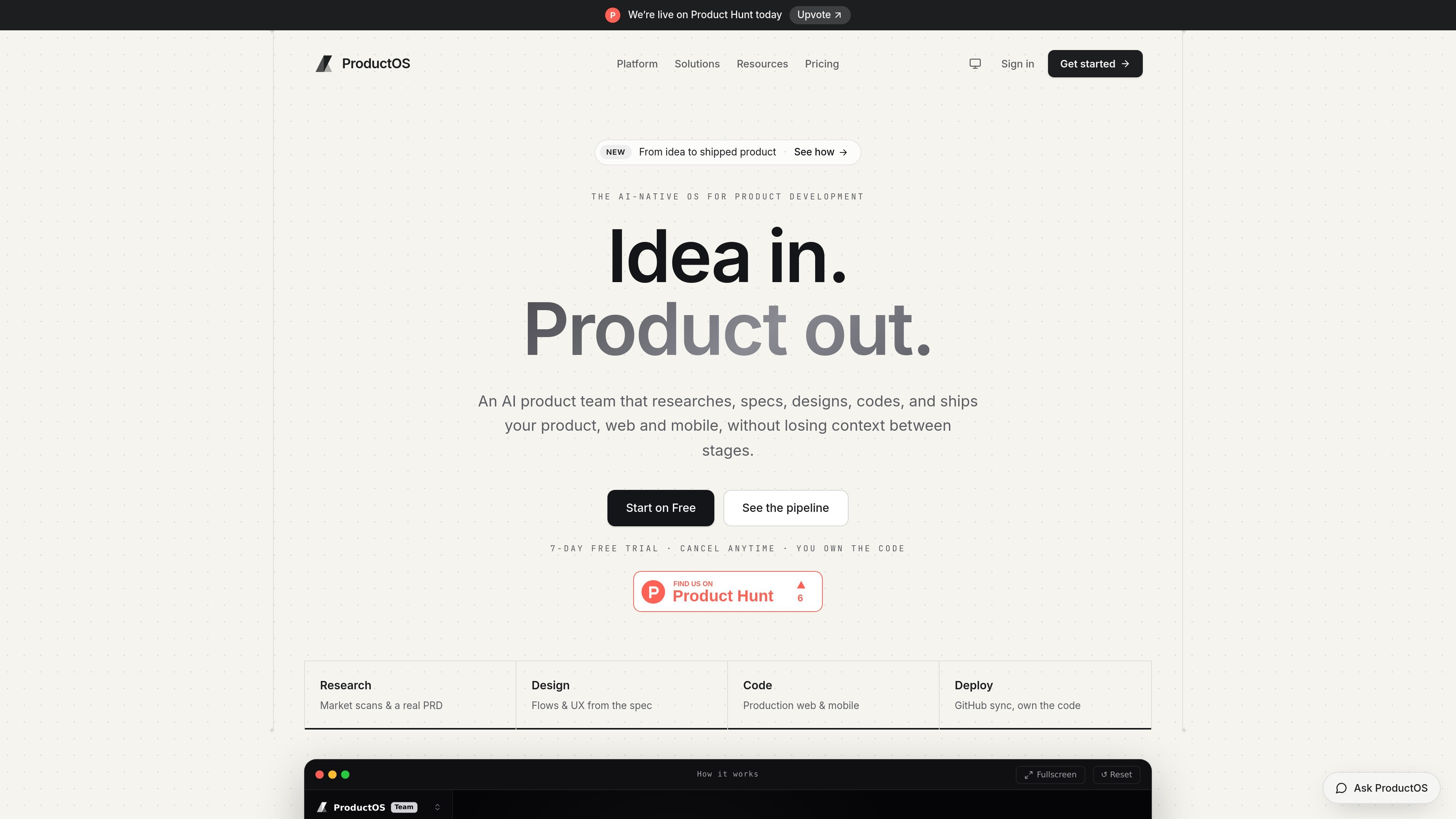
ProductOS is an AI-native product development platform for taking an idea through research, specification, design, coding, and deployment. Its orchestrator coordinates specialized agents that share a project wiki and context, so research can inform the PRD, the PRD can guide design, and the resulting designs can inform implementation.
The platform is designed for people who want to build web and mobile products while retaining control of the output. It supports source-backed market research, structured product documentation, generated user flows and interface screens, production web and native mobile code, live previews, GitHub synchronization, full code export, and deployment with custom domains. Existing products can also be mapped across supported web, mobile, and backend stacks.
Specialized agents cover ideation, research, PRDs, architecture, design, implementation, code review, QA, and deployment. An orchestrator routes work between them.
The research workflow combines SerpAPI, Exa, and Perplexity for market and competitor research, with sources attached to claims and outputs.
Research can be turned into a structured PRD with sections such as press release, FAQs, goals and metrics, personas, acceptance criteria, and edge cases.
The design stages generate brand guidance, user flows, UI screens, design tokens, components, and previews from the product specification.
The platform generates Next.js web applications and native iOS and Android applications via Expo, with a live sandbox preview and deployment workflow.
Users can synchronize projects with GitHub, export the full codebase, use custom domains and SSL, and connect external development tools through MCP.
Turn an early concept into a research-backed opportunity brief, with competitor analysis, positioning, feasibility questions, and a PRD before development begins.
Generate user flows, brand guidance, screen specifications, design tokens, and components from an approved product definition, then iterate before implementation.
Create a working web product with a live sandbox preview, GitHub synchronization, and deployment to a custom domain when a team needs an end-to-end build workflow.
Generate a native mobile product for iOS and Android through Expo, with support for EAS builds, app-store submission workflows, subscriptions through RevenueCat, and over-the-air updates.
Connect an existing codebase or use ProductOS from an IDE through MCP to map a stack, edit files, update product documents, and trigger deployment tasks.
ProductOS coordinates specialized agents for ideation, market research, PRD writing, architecture, design, implementation, code review, testing, and deployment. The agents share project context across stages.
You can start with a free Hobby account that includes a one-time grant of 200 credits. Paid plans add monthly credits and capabilities such as custom domains, GitHub sync, and code export; Enterprise plans are available for organizations with custom requirements.
The workflow begins with an idea, then moves through research and validation, PRD creation, design, code generation, and deployment. Outputs can include market research with sources, a PRD, user flows and screens, web and mobile code, and a deployed preview or product.
ProductOS can generate production web code and native iOS and Android applications through Expo. It also supports GitHub synchronization, full code export, custom domains, and deployment to infrastructure controlled by the user.
ProductOS provides an MCP server with 58 tools that can connect to Claude Code, Cursor, or another MCP client. The tools can be used for tasks such as writing PRD sections, editing files in a live sandbox, and triggering deployments.

ByteAsk is a terminal-first AI coding agent for C and C++ that edits repos and verifies changes with compilers, debuggers, sanitizers, and tests.

CreateOS Sandbox is an isolated compute environment for running code and agent workloads in Firecracker micro-VMs with private networking and SDK, CLI, or MCP control.

GitBot is a local browser workspace for reusable coding bots powered by Claude Code, Codex, or OpenCode, with persistent threads and configurable permissions.

Codex Plugins bundle reusable skills, app integrations, and MCP servers into workflows you can install in the Codex app or use from Codex CLI.

Wallie is an open-source AI streamer that watches your screen, hears chat, and delivers live commentary in a configurable persona. Runs locally with your own keys.

Manta AI is an autonomous web app testing tool that maps app behavior, catches regressions, and generates tests from a URL, no scripts or selectors needed.