
Intelligent business canvas
Organize customers, problems, solutions, channels, value, and economics in a connected business model so gaps, dependencies, and contradictions are easier to identify.

siift is an agentic AI operating system for founders, builders, and teams, uniting idea exploration, validation, prioritization, and human-reviewed workflow automation.
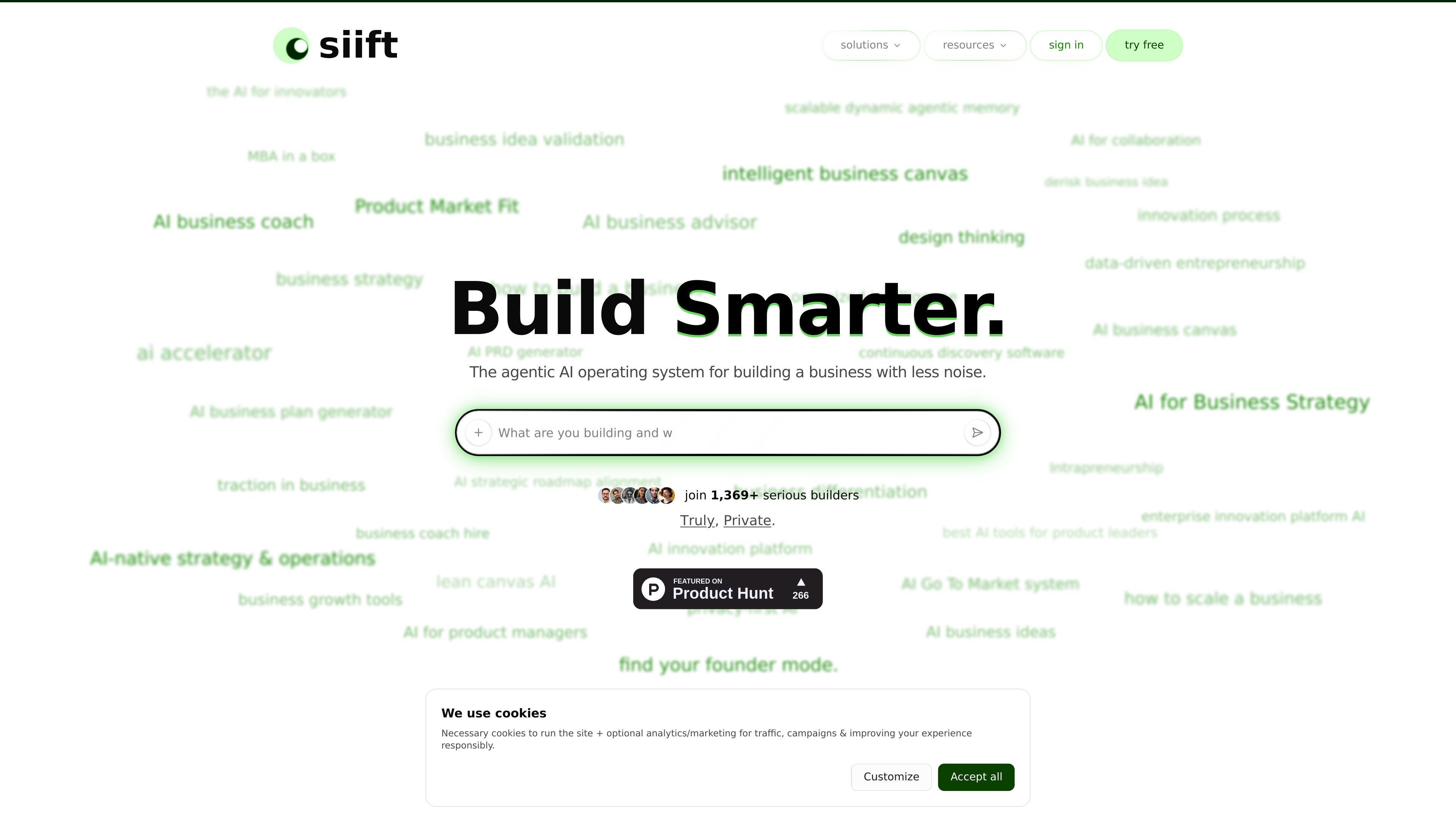
siift is an agentic AI operating system for building businesses. It combines a structured business canvas, evidence tracking, strategic guidance, and workflow automation to help users move from idea exploration to validation, product planning, launch, and growth.
The platform is designed to reduce the gap between plausible AI-generated advice and evidence-based business decisions. It keeps assumptions distinct from validated signals, focuses attention on the uncertainties most likely to affect the business, and updates the working context as new research and feedback arrive. siift is positioned for founders, builders, and teams that need a connected way to compare ideas, test demand, prioritize work, and coordinate decisions.
Organize customers, problems, solutions, channels, value, and economics in a connected business model so gaps, dependencies, and contradictions are easier to identify.
Keep multiple audiences, problems, offers, and business-model directions in one workspace rather than overwriting ideas or creating separate canvases.
Separate assumptions, observations, and verified signals, then rank uncertainty by business impact and score the strength of supporting evidence.
Turn open-ended research into focused interviews, competitor research, landing-page tests, and other experiments with a defined learning objective or decision.
Carry research, customer quotes, results, and validated feedback into the evolving business context so later guidance reflects the latest evidence.
Provide step-by-step recommendations and transparent, human-in-the-loop actions across more than 80 applications, with shareable workspaces and views for collaborators.
Compare customer, problem, solution, channel, and revenue possibilities in one canvas. The platform keeps alternatives connected while evidence and coherence shape which combinations deserve further attention.
Before investing heavily in development, map the assumptions behind a concept, identify the riskiest ones, and run targeted interviews, research, or market tests to assess urgency, willingness to pay, and reachability.
Use structured context and evidence to choose a narrower useful solution, reduce avoidable product risk, and prioritize work that is most likely to affect the business decision.
When a startup is stalled or traction is weaker than expected, revisit the evidence behind its positioning, target segment, or acquisition channel and identify the assumption that needs retesting.
Share business views with teammates, advisors, or stakeholders and use guided, human-reviewed actions to coordinate research and operational work as the business develops.
siift maps the assumptions behind an idea, identifies those with the greatest business impact, recommends focused validation steps, turns evidence into structured confidence scores, and connects the evidence back to the business strategy.
Yes. It is intended for use before a full product build, including testing the problem, customer, value proposition, pricing assumptions, and routes to market.
No. Customer conversations, sales attempts, and observed behavior remain important validation sources. siift helps users decide whom to speak with, what to test, and how to interpret the results.
siift does not cover HR, legal, compliance, or finance, which the company excludes because of regulatory risks.
Users receive free credits on signup, and usage consumes credits based on the proportional effort of an agent turn. Unused credits do not roll over to the next month.

Codex Plugins bundle reusable skills, app integrations, and MCP servers into workflows you can install in the Codex app or use from Codex CLI.
Struere turns spreadsheet data into structured operational software with dashboards, alerts, and automations for teams replacing manual spreadsheet workflows.

Wysera is an AI business platform with PostWyse for content and OpsWyse for CRM and revenue workflows, powered by shared Wyse AI and approval-first automation.
OpenFlags is an open-source, self-hosted feature flag platform for JavaScript teams, with local evaluation, targeted rollouts, and controlled launches.

Awish is an AI no-code automation platform that turns natural-language requests into workflows across connected apps—no manual setup.

Codeswtch is an engineering subscription for founders building with AI, offering senior engineering guidance and hands-on help in one ongoing plan.