
SQLite-compatible, region-expandable database
Create a SQLite-compatible database on bunny.net’s network and start in a single region, then add more regions later without changing your application design.

Bunny Database is a SQLite-compatible DBaaS from bunny.net for read-heavy apps needing low-latency access across regions, with libSQL SDKs, HTTP, and usage-based pricing.
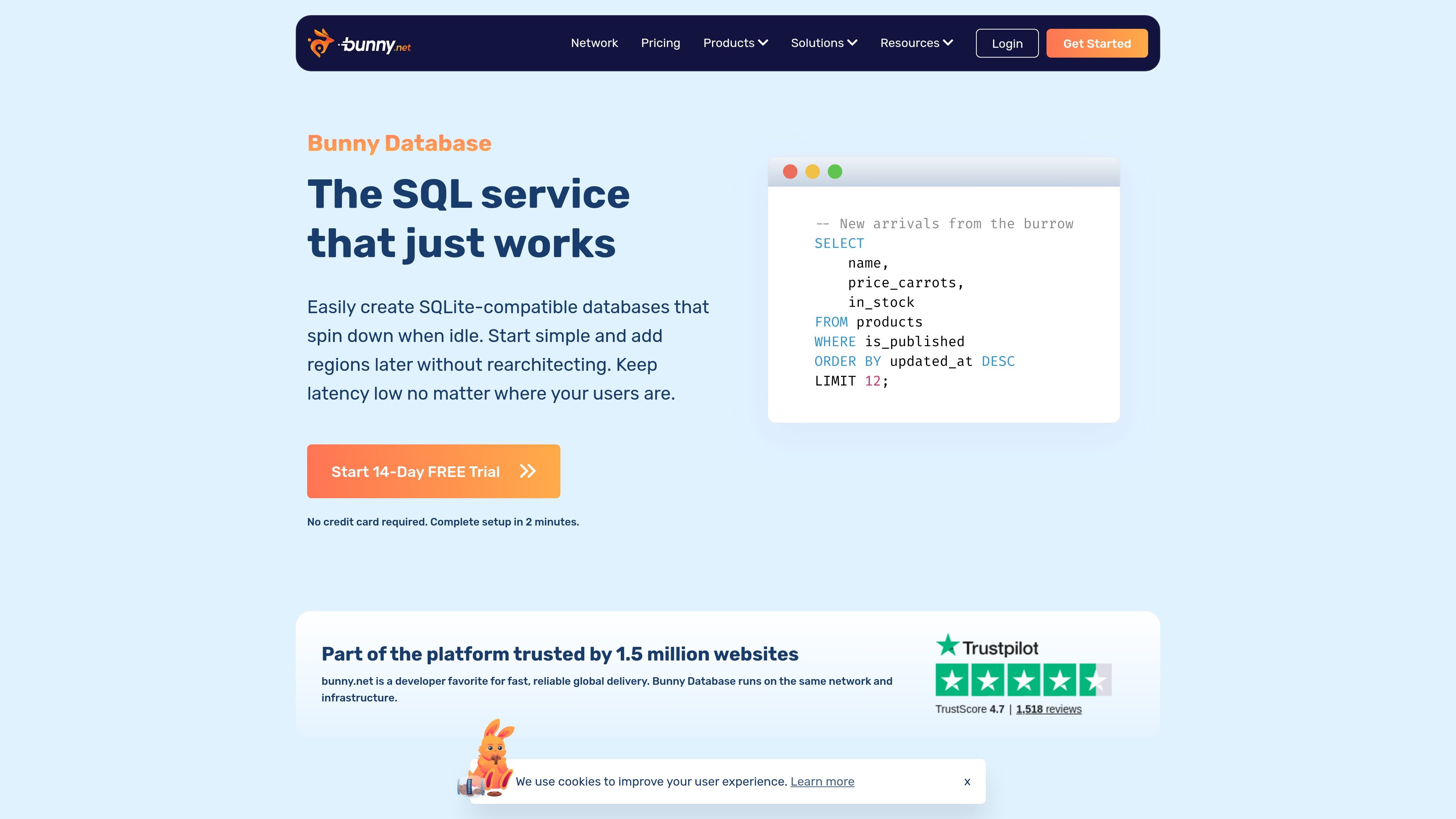
Bunny Database is a SQLite-compatible database service from bunny.net. It is designed to spin down when idle, start in one region, and expand to more regions later without forcing a rearchitecture.
The product is positioned as a simple DBaaS for read-heavy applications that need low latency across geographies. It runs on bunny.net’s global network and exposes familiar libSQL SDKs for TS/JS, Go, Rust, and .NET, with HTTP access also available when needed.
Create a SQLite-compatible database on bunny.net’s network and start in a single region, then add more regions later without changing your application design.
Choose from 41 regions and serve reads closer to users to keep round-trip times low across distributed audiences.
Use official libSQL SDKs for TS/JS, Go, Rust, and .NET, or connect over HTTP when you need a more general interface.
Inspect tables, run SQL, and check data directly from the product experience, instead of jumping between separate admin tools.
Track latency, traffic, and storage as the database scales so you can watch how usage changes over time.
When the database is idle, the source says it only incurs storage costs, with read replicas adding storage costs only when serving traffic.
Store structured catalog data, location lists, or directory content that users browse more often than they update.
Keep tags, categories, and other lookup data available for filtering and sorting without heavy database overhead.
Serve account settings, preferences, and lightweight per-user state for applications that need simple relational storage.
Centralize low-churn settings for an application, tenant, or environment and expand regions later as traffic spreads.
Support teams that want to inspect SQL and track latency, traffic, and storage without moving to a separate operational stack.
Bunny Database is a SQLite-compatible database service on bunny.net’s global network. The source says it is built for low-latency access, can be started in one region, and expanded to more regions later without rearchitecting.
The source says you can connect with familiar libSQL SDKs for TS/JS, Go, Rust, and .NET, or use HTTP when needed. Access tokens can be used as environment variables, which fits typical app and script setups.
It is positioned for read-heavy workloads such as catalogs and directories, metadata and filtering, user profiles, and app configuration. The page explicitly says it works best for read-heavy use cases.
The pricing section says usage is charged continuously and invoiced monthly, and that reads, writes, and storage are billed separately. It also says Bunny Database is free while in public preview.
The page mentions 41 available regions, read replicas, and metrics for latency, traffic, and storage. It also says Bunny Database runs standalone and can be paired with Edge Scripting or Magic Containers.

Mindcase is a web data API and console for extracting structured data from websites and major platforms, with prompt or API access and prepaid per-record billing.
NodeDB is a universal database engine combining relational, vector, graph, document, columnar and scientific array data in one Rust binary with PostgreSQL client compatibility.

Mailercloud Email Verifier checks email addresses in bulk, one by one, or via API to reduce bounces and improve deliverability.

Metabase Data Studio is a semantic layer and analytics workbench for cleaning, defining, and publishing reusable data in Metabase. Keeps metrics and datasets consistent.

NewsCatcher Platform is a web app for creating custom news datasets and tracking stories from web search results, with citation-backed records for analysis and AI workflows.

Happenstance is an AI-powered network search tool to find people, mutual connections, and warm introductions across connected accounts, with API, MCP, Slack, and team integrations.