
AI documentation verification
Fern checks help-center claims against connected product context, drafts fixes for changed information, and lets a team review changes before publishing.

Ferndesk is help-center software for software teams, combining verified knowledge bases, AI updates, self-service widgets, analytics, migrations, and integrations.
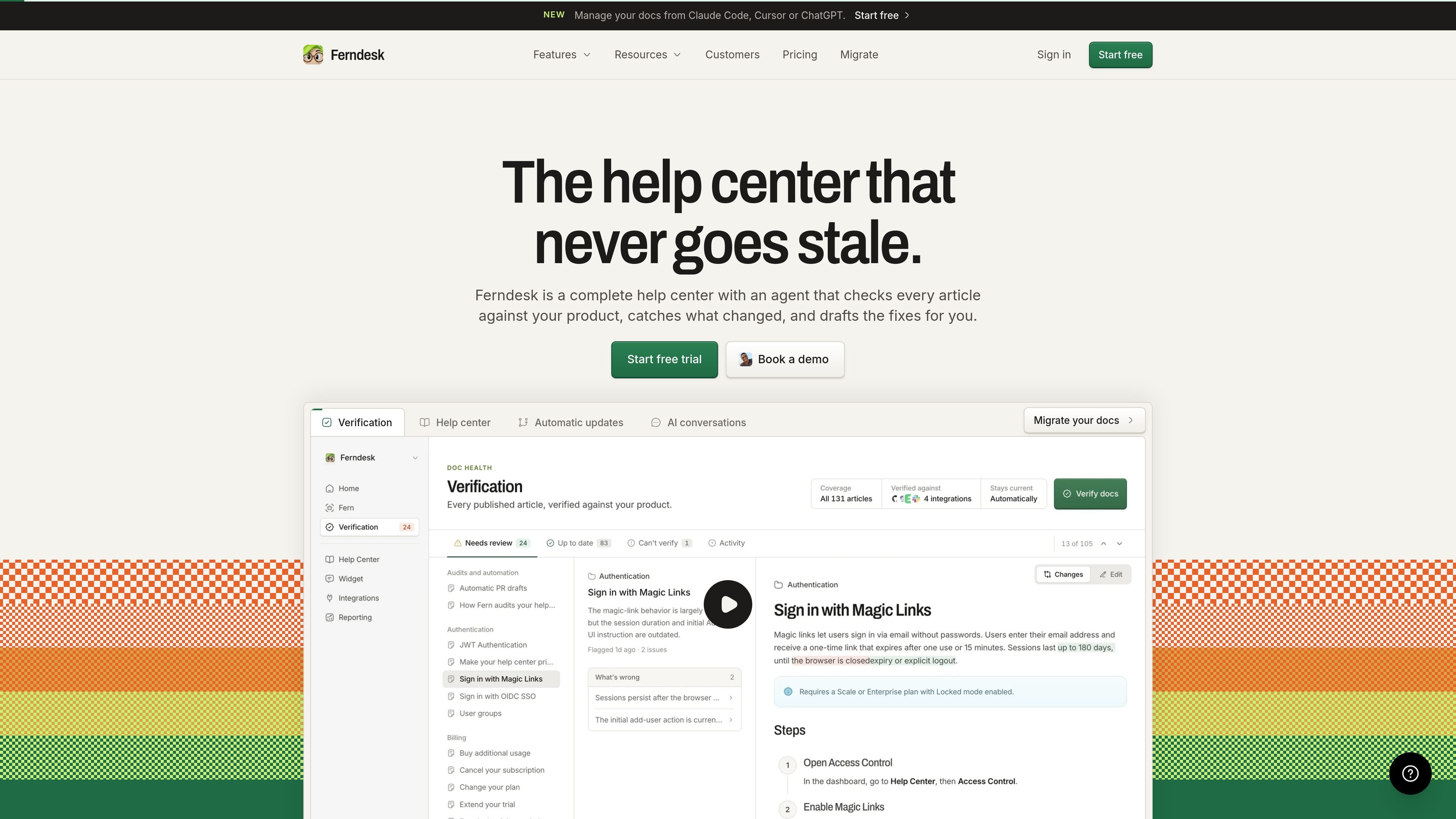
Ferndesk is a help-center platform for software teams that want to keep customer documentation aligned with a changing product. Its Fern agent checks articles against product context, identifies information that has changed, and drafts updates or missing articles for review.
The platform combines a public or private knowledge base with AI conversations, an embedded help widget, API documentation, translations, analytics, and migration tools. Teams can connect their codebase, support systems, product dashboard, and other documentation sources so product changes and customer questions can inform the next documentation update.
Fern checks help-center claims against connected product context, drafts fixes for changed information, and lets a team review changes before publishing.
Automatic PR screening and scheduled audits identify documentation changes as the product evolves. Fern can also draft articles from code changes, issues, support conversations, and other connected sources.
Publish a searchable public help center on a custom domain or a /help subfolder. Ferndesk also supports private or authenticated documentation using magic links, OIDC, or JWT.
Add a single script tag to provide search, articles, and AI conversations inside an application. The widget can appear as a floating button, sidebar, or modal and can hand off unanswered requests to Intercom, Zendesk, or Help Scout.
Import articles, collections, images, and attachments from existing help centers while preserving URLs and creating 301 redirects. Ferndesk lists imports from Intercom, Zendesk, Crisp, Help Scout, HubSpot, GitBook, Document360, and other help centers.
Connect support platforms, GitHub, Linear, Slack, Discord, Gmail, product dashboards, or a custom support endpoint. Analytics include searches, missed searches, failed answers, and feedback.
After a release changes settings, pricing, workflows, or other product behavior, Fern can use code changes and pull requests to identify affected documentation and prepare updates before or around the release.
A team can import an existing help center, preserve its URL structure with redirects, and move the customer-facing knowledge base without replacing its existing inbox, chat, or ticketing system.
Product teams can place the widget inside their application so customers can search, read articles, and ask questions without opening a separate documentation tab. Unanswered requests can be collected for follow-up.
Support and documentation teams can connect resolved conversations, tickets, feedback, and chat threads to find recurring questions or gaps, then use search and failed-answer analytics to prioritize new content.
No. Existing articles are imported into Ferndesk, with URLs preserved and 301 redirects created. Fern then verifies and updates the copies in Ferndesk; the existing support, inbox, chat, and ticketing tools remain in place.
Fern checks articles against connected product context such as the codebase and live product, then identifies changed claims and drafts revisions for review. The source says that nothing is published without approval.
The widget can be added with one script tag and displayed as a floating button, sidebar, or modal. It uses help-center content to answer questions and can collect customer information for human follow-up when it cannot answer.
Ferndesk says migration takes about ten minutes and brings over articles, collections, images, and attachments. It preserves existing URLs and creates 301 redirects, while your support tools stay where they are.
Yes. Ferndesk offers a 7-day trial without a credit card. Its listed Pro plan is $149 per month, or $1,490 annually with two months free; an enterprise plan is listed from $399 per month.

Falconer is an AI-powered company brain that keeps internal docs accurate, searchable, and up to date by syncing with GitHub, Slack, and Linear.

Goldfish is an AI memory app for macOS that helps you reply, write, summarize, and continue with context already on your Mac. It stores memory locally and writes in your tone.

Lasso is an ecommerce product data platform for enriching catalog records, processing supplier files, generating product content, and tracking competitors. It includes a web app, REST API, SDK, and MCP server.

ArtDeck is a visual reference board app for iPhone, iPad, and Mac. Collect mixed references on one canvas and study them with ToolBox lenses. Offline, optional iCloud sync, one-time purchase.

Struere turns spreadsheet data into structured operational software with dashboards, alerts, and automations for teams replacing manual spreadsheet workflows.

garden-md is an open-source Node.js CLI that turns meeting transcripts into a local company wiki, linking entities and preserving the original text.