
Client-brief translation
Turn calls, job descriptions, and hiring-manager tradeoffs into an actionable search strategy with must-have and flexible requirements.

Jellyfish is AI recruiting software for staffing agencies, turning client requirements into evidence-based searches, outreach, reply management, and recruiter updates.
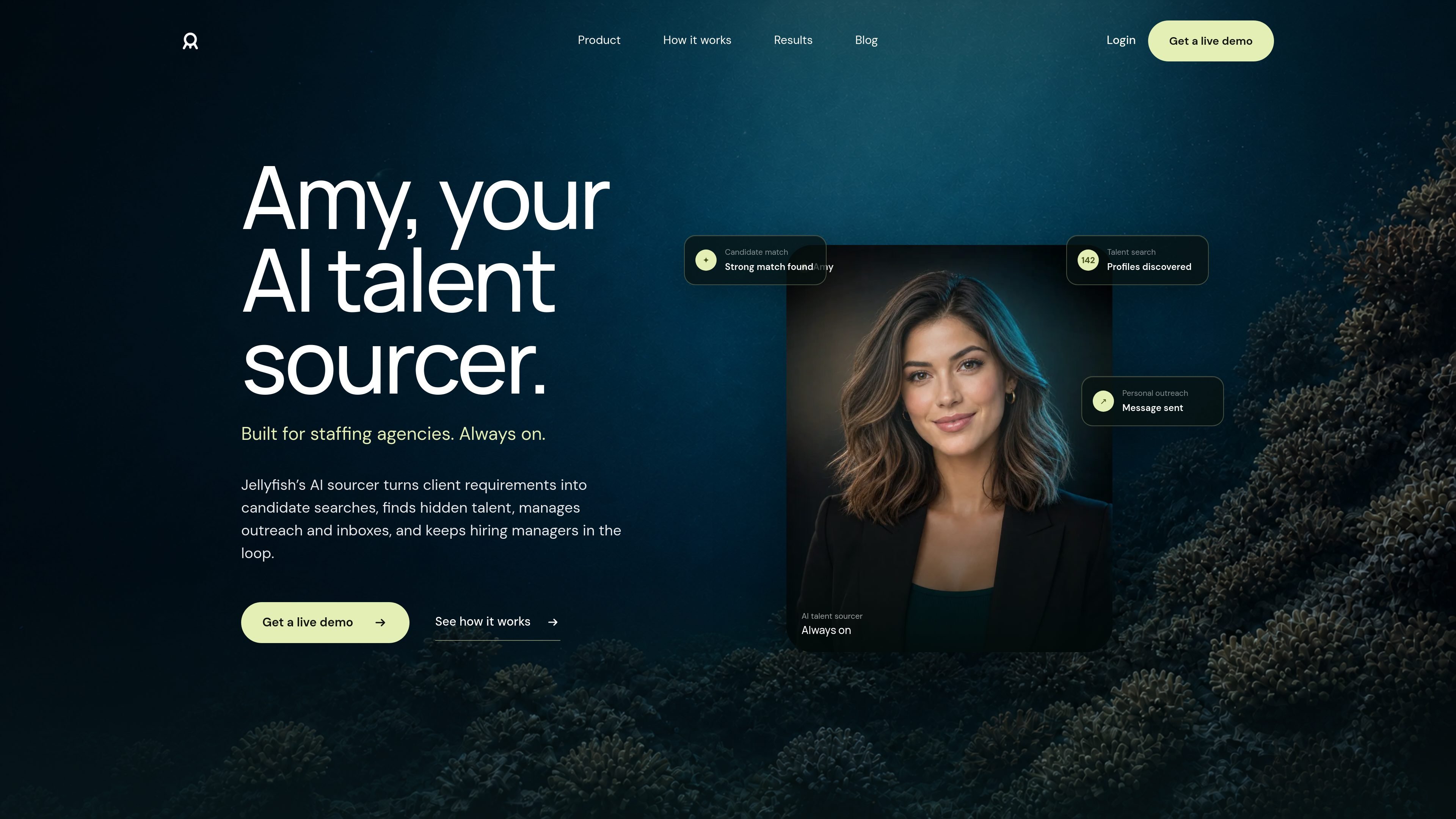
Jellyfish is AI recruiting software for staffing agencies. Its AI talent sourcer, Amy, handles the operational workflow between a client brief and a qualified candidate conversation: translating requirements into a search, researching talent, explaining matches, conducting outreach, managing replies, and coordinating updates.
The product is designed for searches where job titles and conventional profile databases do not fully describe the required experience. Amy can look for evidence in technical work, research, open-source contributions, communities, portfolios, talks, patents, and other public career signals, then connect that evidence back to the client’s requirements. Recruiters can use a more autonomous workflow or retain approval over candidates, messages, and updates.
Turn calls, job descriptions, and hiring-manager tradeoffs into an actionable search strategy with must-have and flexible requirements.
Research technical work and experience across GitHub, Google Scholar, open-source projects, technical communities, and the open web.
Assess candidates against the actual brief and explain matches with role-specific evidence, such as technical depth, scale, leadership, or current intent.
Create personalized engagement sequences, including email, LinkedIn connection and follow-up steps, and InMail, with review points where needed.
Read candidate replies, answer routine questions, summarize responses, route strong candidates to the right recruiter, and keep next steps visible.
Keep client context attached to candidate decisions and provide progress, evidence, and hiring-manager updates as the search develops.
Convert a hiring-manager conversation or job description into explicit must-haves, flexible criteria, and a search plan that retains the original client context.
Find technically qualified people whose relevant work is hidden behind broad titles such as Software Engineer or Product Engineer, using evidence of integrations, deployments, customer work, or other concrete outcomes.
Run a repeatable engagement sequence, answer routine candidate questions, and surface interested or qualified replies so recruiters can focus on conversations requiring judgment.
Keep match evidence, candidate decisions, follow-ups, and progress updates connected when several recruiters or hiring stakeholders are involved in a search.
Use approval checkpoints for candidates, messages, or updates when a team wants AI to perform the routine work while recruiters retain control over consequential decisions.
Jellyfish is AI recruiting software for staffing agencies. Its AI talent sourcer, Amy, converts client requirements into a search plan, researches candidates, evaluates evidence, runs outreach, manages replies, and keeps hiring teams updated.
Amy searches beyond conventional profile databases, including GitHub, Google Scholar, open-source projects, technical communities, and the open web. It looks for evidence of relevant work rather than relying only on job titles or keywords.
The workflow can run with different levels of human involvement. Teams can let Amy source, engage, follow up, and coordinate, or require approval for candidates, messages, and client updates. The brief, rules, and autonomy level can be changed as the work progresses.
Amy produces candidate matches with role-specific supporting evidence, personalized outreach, handled or summarized replies, qualified-candidate handoffs, and progress updates for recruiters or hiring managers.

HiringPartner.ai is an autonomous AI recruiting platform for sourcing, screening, and interviewing candidates 24/7 with ATS-connected workflows and bulk resume uploads.

SelectPrism is an agentic AI hiring platform for high-volume recruiting teams. Automates screening, scheduling, first-round interviews, and structured evaluation.

Fountain is a frontline workforce platform for high-volume hiring, onboarding, sourcing, and scheduling, with Frontline OS and AI-assisted workflows.

CmdRound is a recruiter-focused engineering assessment tool for evaluating candidates with Claude Code on real coding tasks, featuring scorecards and chronological replay.

Elvixs is an AI job outreach tool for freshers and students that finds hiring contacts, writes personalized cold emails, sends from Gmail, and tracks opens and replies.

Badge turns anonymous peer reviews into a Trust Score, helping job seekers, freelancers and candidates show proof of work to recruiters.