
Warehouse-native analytics agent
Ask natural-language questions and get a diagnosis that runs directly against your warehouse data, instead of waiting on a manual SQL request.

Mitzu is an analytics agent that answers questions, monitors KPIs, and runs deep product analysis on your data warehouse for self-serve analytics without SQL or tickets.
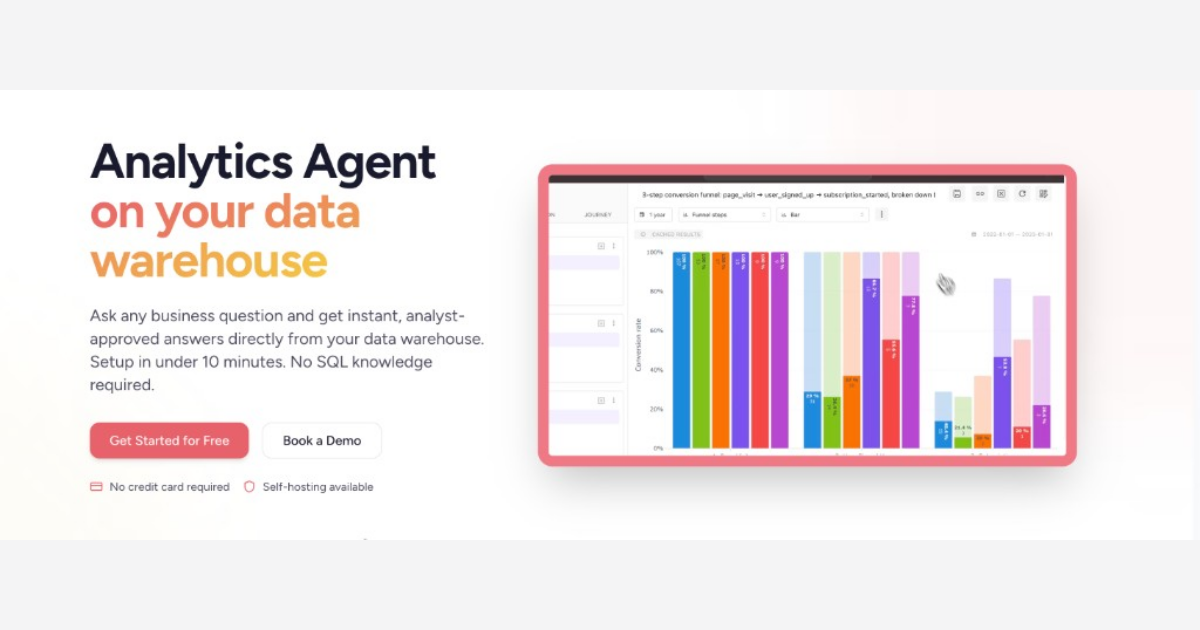
Mitzu is an analytics agent that works on top of your data warehouse. It answers questions, monitors KPIs, and runs deeper investigations automatically, using the same source data your team already owns. The product is positioned for teams that want self-serve analysis without routing every request through SQL or tickets.
The site emphasizes product analytics workflows rather than generic chat responses. Mitzu supports funnels, retention, cohorts, segmentation, and journey analysis, and it can generate SQL-backed findings, surface anomalies, and explain the logic behind each answer. The result is an assistant that is meant to help analysts and business users explore product behavior with traceable output and warehouse-native execution.
Ask natural-language questions and get a diagnosis that runs directly against your warehouse data, instead of waiting on a manual SQL request.
Investigate changes in conversion, retention, or engagement by combining funnels, cohorts, segment comparisons, and journey exploration in one analysis flow.
Track metric shifts, retention anomalies, and activation drops automatically so issues surface without someone needing to query them first.
See the generated SQL for every answer, approve queries before sharing, and work from the same logic your warehouse uses.
Connect to common warehouse and event sources, including Snowflake, BigQuery, Databricks, Redshift, ClickHouse, Firebase, GA4, and custom schemas.
Use the journey, funnel, retention, segmentation, and cohort experiences to explore behavior through the product analytics workflow the engine is built around.
A product team can ask why conversion, activation, or retention changed after a release or campaign and use Mitzu’s warehouse-backed analysis to trace the likely drivers.
Analysts can investigate a funnel, retention window, or cohort pattern without building a separate report each time, then review the generated SQL before sharing the finding.
Teams can watch KPIs for shifts such as retention anomalies or activation drops and receive surfaced insights before the issue is manually investigated.
Growth or product teams can follow user paths through journeys, identify drop-off points, and click into a node to generate a SQL query or segment for deeper review.
B2B teams can track company-level engagement, churn risk, and expansion signals using the account analytics workflow described on the product site.
Mitzu connects to your data warehouse, scans the schema, and creates a semantic layer before you start asking questions. The site says setup can be done in under 10 minutes.
The pricing page says the product is offered with a 14-day free trial on the Team plan and a free-to-start entry point. It also shows a contact-sales path for larger deployments.
Mitzu can answer questions, monitor KPIs, run deep analysis, and generate outputs such as SQL queries, funnels, retention views, and journey diagrams.
The site positions Mitzu for analysts, data teams, product teams, and business teams that need self-serve analytics without writing SQL for every request.
The public site states that Mitzu works with warehouses and data sources including Snowflake, BigQuery, Databricks, Redshift, ClickHouse, Firebase, GA4, and custom event schemas, with more deployment options on higher tiers.

PromptScout tracks how ChatGPT, Gemini, Google AI Overviews, and Perplexity mention your brand or competitors, with source analysis and website audits.

SaveMRR is a Stripe retention tool for SaaS teams to scan churn and MRR leaks, then automate recovery with dunning, cancel-save offers, win-back emails, and onboarding nudges.

Hype is a web tool for finding trending YouTube topics by category, time range, and scoring mode. Spot emerging ideas and review source videos.

Sleek Analytics is a privacy-friendly web analytics tool with real-time visitor tracking, Core Web Vitals, and revenue attribution.

Struere turns spreadsheet data into structured operational software with dashboards, alerts, and automations for teams replacing manual spreadsheet workflows.

ClayHog is an AI search visibility platform for tracking brand presence in ChatGPT, Gemini, Perplexity, Claude, and Google AI Overviews from one dashboard.