
Debit cards for agents
The homepage positions Agentcard as a way to issue a debit card for an AI agent, with the card intended for agent-driven spending rather than manual use.

Agentcard is a payments product for issuing single-use virtual debit cards to AI agents. The public site says the cards work without a wallet or prefunding and are accepted everywhere Visa is.
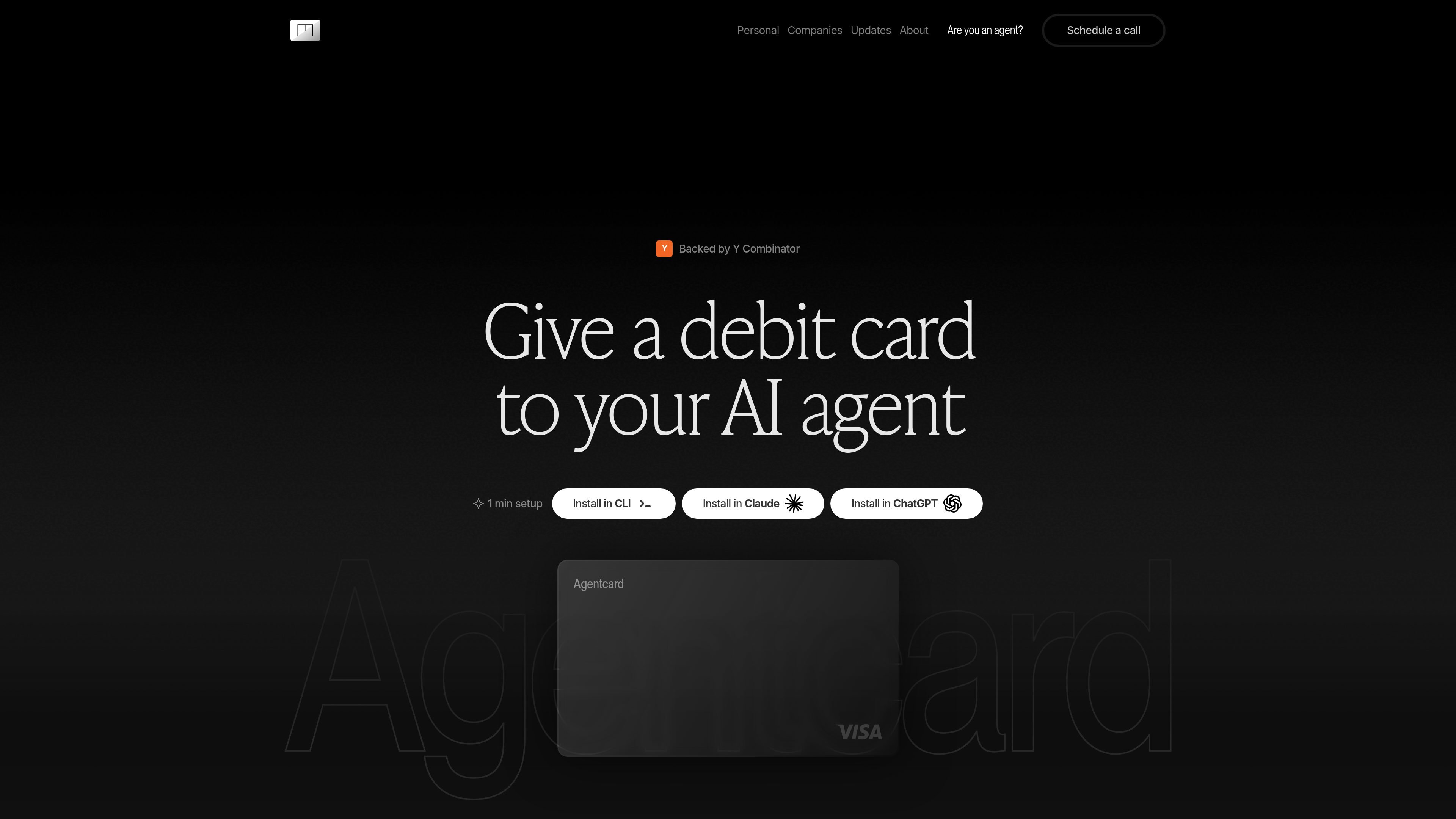
Agentcard is a payments product for issuing debit cards to AI agents. Its homepage presents the core idea as giving an agent a single-use virtual card so it can spend on its own, without requiring a human to complete the payment step.
The public messaging emphasizes a simple funding model: no wallet and no prefunding. The site also says the cards are accepted everywhere Visa is, which places Agentcard in the card-issuing and agent-payment infrastructure category rather than a general-purpose wallet or consumer card app.
The homepage positions Agentcard as a way to issue a debit card for an AI agent, with the card intended for agent-driven spending rather than manual use.
The product description says cards are single-use virtual cards, which suggests a spend model oriented around one transaction or one purchase flow per card.
The site says the agent can spend on its own, so the core workflow is built around autonomous payment completion instead of human handoff at checkout.
The homepage states there is no wallet and no prefunding, indicating a simplified funding model compared with a stored-value wallet workflow.
The homepage says the cards are accepted everywhere Visa is, which defines the visible payment network compatibility on the source page.
The page presents scoped spend limits as a desirable guardrail in user quotes, but the public copy does not show configurable limit controls or their exact behavior.
Issue a dedicated card for a specific agent task, such as a purchase or subscription checkout, when you want that workflow to complete without manual payment entry.
Use a one-time virtual card when you want to keep an agent’s spending scope narrow and avoid reusing the same payment credential across tasks.
Set up a payment path for workflows that need a card accepted at Visa merchants, based on the network compatibility stated on the homepage.
Replace a human handoff at the final payment step with a card the agent can use directly, keeping the workflow inside the automation layer.
Choose a card-issuing approach instead of a wallet-style product when you want the site’s stated no-wallet, no-prefunding model.
The site describes Agentcard as a way to give an AI agent a debit card and issue single-use virtual cards the agent can spend on its own. The public page does not show setup steps or a full workflow.
The homepage says the cards are accepted everywhere Visa is. No other network, rail, or geographic availability details are shown on the provided pages.
The homepage highlights single-use virtual cards and says there is no wallet and no prefunding. It does not provide details on card limits, funding mechanics, or admin controls on the pages provided.
A pricing page URL exists, but the provided source returned a 404. There are no public pricing numbers, tiers, or fees in the supplied material.
The provided content does not include docs, dashboard screenshots, API references, or integration details, so those capabilities cannot be confirmed from the supplied pages.

AakarDev AI helps teams manage AI provider access, project-level setups, logs, and analytics from one dashboard. It supports BYOK workflows and lists providers including OpenAI, Google Gemini, Anthropic, Groq, Mistral AI, and Perplexity AI.

Arduino VENTUNO Q is an edge AI computer for AI and robotics applications. It combines AI inference and deterministic control on a single board and is designed to work with Arduino App Lab.

Devin is an AI coding agent and software engineer that helps developers and engineering teams plan and execute complex software tasks. It is available through desktop, cloud, JetBrains, and CLI surfaces, with plans for individuals, teams, and enterprises.

Open Computer Use is an open-source Computer Use service wrapped as MCP for macOS, Linux, and Windows. It helps AI agents and MCP clients run desktop automation workflows through client setup commands or manual MCP configuration.

Lasso is an ecommerce product data platform for enriching catalog records, processing supplier files, generating product content, and monitoring competitors. It combines a web app with a REST API, SDK, and MCP server for teams and developers.

DailyPlay.ai is a behavioral growth platform using AI site scans and micro-games to boost engagement and conversions across web, mobile, and more.