
Variance analysis
Investigates changes in financial results and traces variances back through the underlying data, with calculation lineage for the resulting explanation.

Datawyse is an agentic financial analysis tool for SMB CFOs and mid-market teams. Investigate variances, forecast cash, model scenarios, and prepare traceable reports.
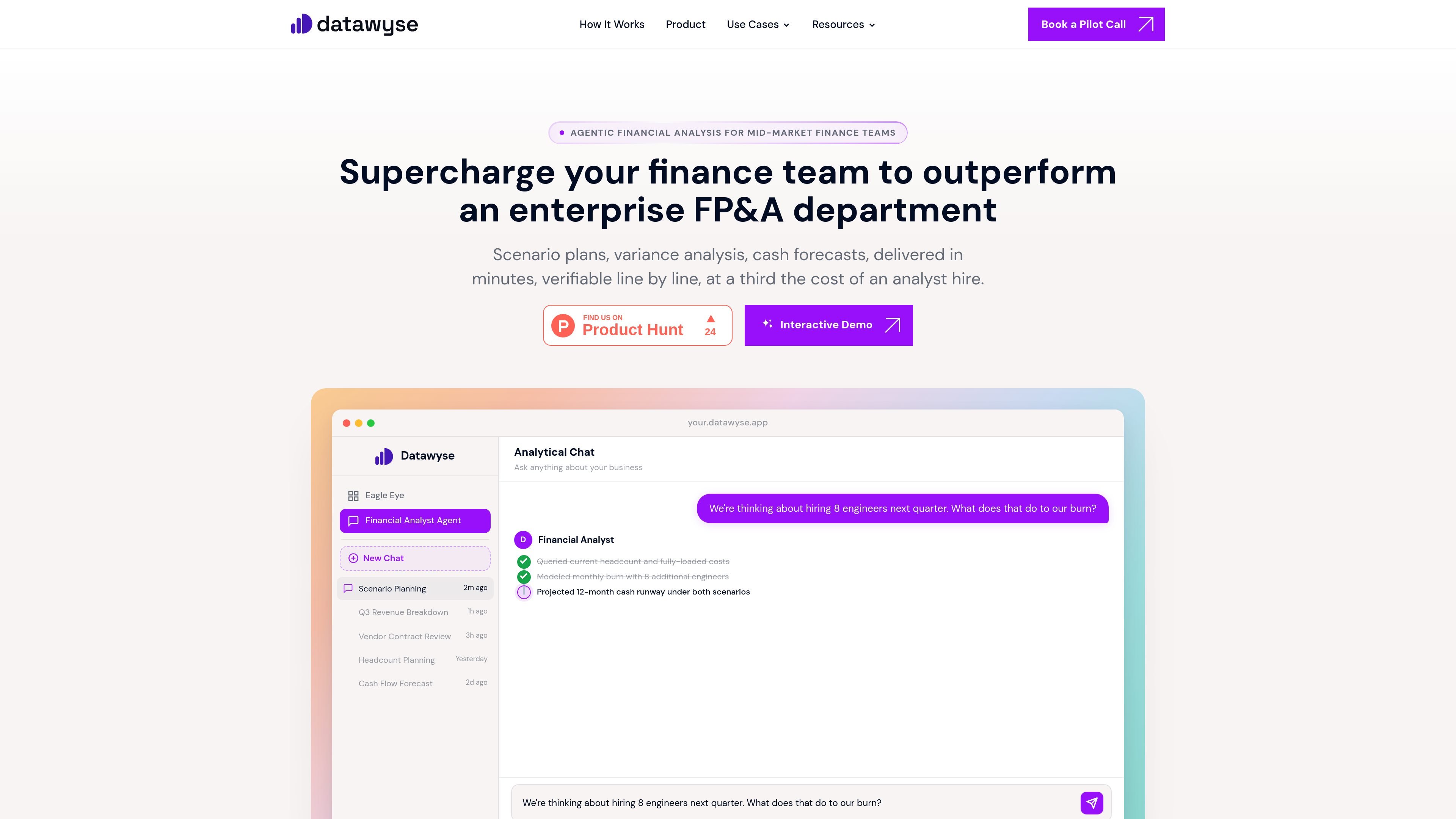
Datawyse is an agentic financial analysis tool for SMB CFOs and mid-market finance teams. It is positioned between a general-purpose AI chat tool and a conventional FP&A workflow: instead of only reporting what happened, it helps investigate why results changed and model what could happen next.
The product supports variance deep-dives, cash forecasts, scenario plans, P&L analysis, expense monitoring, revenue analysis, budget tracking, and board preparation. Its workflow combines connected business data with company-specific definitions, targets, budgets, and patterns, then uses finance agents to produce answers with calculation lineage and line-by-line verification. The site also describes continuous alerts and customized reports, while leaving specific integrations, pricing, and setup requirements unspecified.
Investigates changes in financial results and traces variances back through the underlying data, with calculation lineage for the resulting explanation.
Produces cash-flow forecasts that account for receivables, payables, and seasonal patterns, with alerts when cash falls below a defined floor.
Models best-case, worst-case, likely, and other decision scenarios, showing effects on cash, margin, profitability, runway, or break-even timing.
Generates P&L breakdowns with trend analysis, margin tracking, and anomaly detection, and supports follow-up questions about findings.
Checks expenses against budgets and policies to identify vendor overages, off-policy purchases, low-utilization subscriptions, and other potential margin leaks.
Uses company-specific targets, KPI definitions, budget data, seasonality, and business rules as context for finance agents that plan, fetch, analyze, verify, and model data.
Compare a quarter's results with the prior period, identify the line items and cost drivers behind a margin change, and separate recurring performance from one-time events.
Project the next 12 weeks of cash using receivables, payables, and seasonal patterns, then receive an alert when the forecast approaches the organization's cash floor.
Evaluate a hiring plan or other investment by comparing its effect on burn, runway, cash, margin, and milestone timing across multiple scenarios.
Review vendor and subscription spend, compare utilization with contract cost, and identify expenses or departmental lines that warrant investigation before they compound.
Prepare a board summary with KPIs, trends, and talking points, then use follow-up analysis to answer questions raised during preparation or the meeting.
Datawyse is designed for mid-market finance teams and SMB CFOs that need analysis for questions such as variance explanations, cash forecasts, scenarios, P&L reviews, and board reporting. The site's fit guidance notes that an FP&A platform may be a better match when consolidation is the primary bottleneck, and that human judgment remains important for genuinely novel strategic work.
The site says Datawyse connects to an ERP, CRM, and business tools, then applies business context such as targets, seasonality, KPI definitions, budgets, and operating rules. Specific supported systems and detailed onboarding requirements are not published in the supplied evidence.
Datawyse presents financial answers with calculation lineage and says numbers are verifiable line by line, including the formulas behind outputs. The supplied material does not specify every output format or the exact audit and export workflow.
The product covers variance analysis, cash-flow forecasting, scenario planning, P&L analysis, expense monitoring, revenue segmentation, board reporting, and budget-versus-actual tracking. It also describes daily checks and automated reports, although the exact configuration options are not detailed.
No pricing plans or prices are available in the supplied evidence. The pricing URL returns a not-found page, while the site invites prospective users to book a 30-minute pilot call on actual financial data.

PromptScout tracks how ChatGPT, Gemini, Google AI Overviews, and Perplexity mention your brand or competitors, with source analysis and website audits.

SaveMRR is a Stripe retention tool for SaaS teams to scan churn and MRR leaks, then automate recovery with dunning, cancel-save offers, win-back emails, and onboarding nudges.

Hype is a web tool for finding trending YouTube topics by category, time range, and scoring mode. Spot emerging ideas and review source videos.

Sleek Analytics is a privacy-friendly web analytics tool with real-time visitor tracking, Core Web Vitals, and revenue attribution.

Struere turns spreadsheet data into structured operational software with dashboards, alerts, and automations for teams replacing manual spreadsheet workflows.

ClayHog is an AI search visibility platform for tracking brand presence in ChatGPT, Gemini, Perplexity, Claude, and Google AI Overviews from one dashboard.