
Basic and advanced AI scans
Run a basic scan or an advanced scan depending on how much analysis you need. The advanced scan is described as offering 99.98% accuracy and deeper detection for subtle or mixed AI-generated content.

Winston AI is a web-based AI content detector and plagiarism checker with a separate API for product and research workflows. Text scans, file upload, URL import, shareable reports, and sentence-level results.
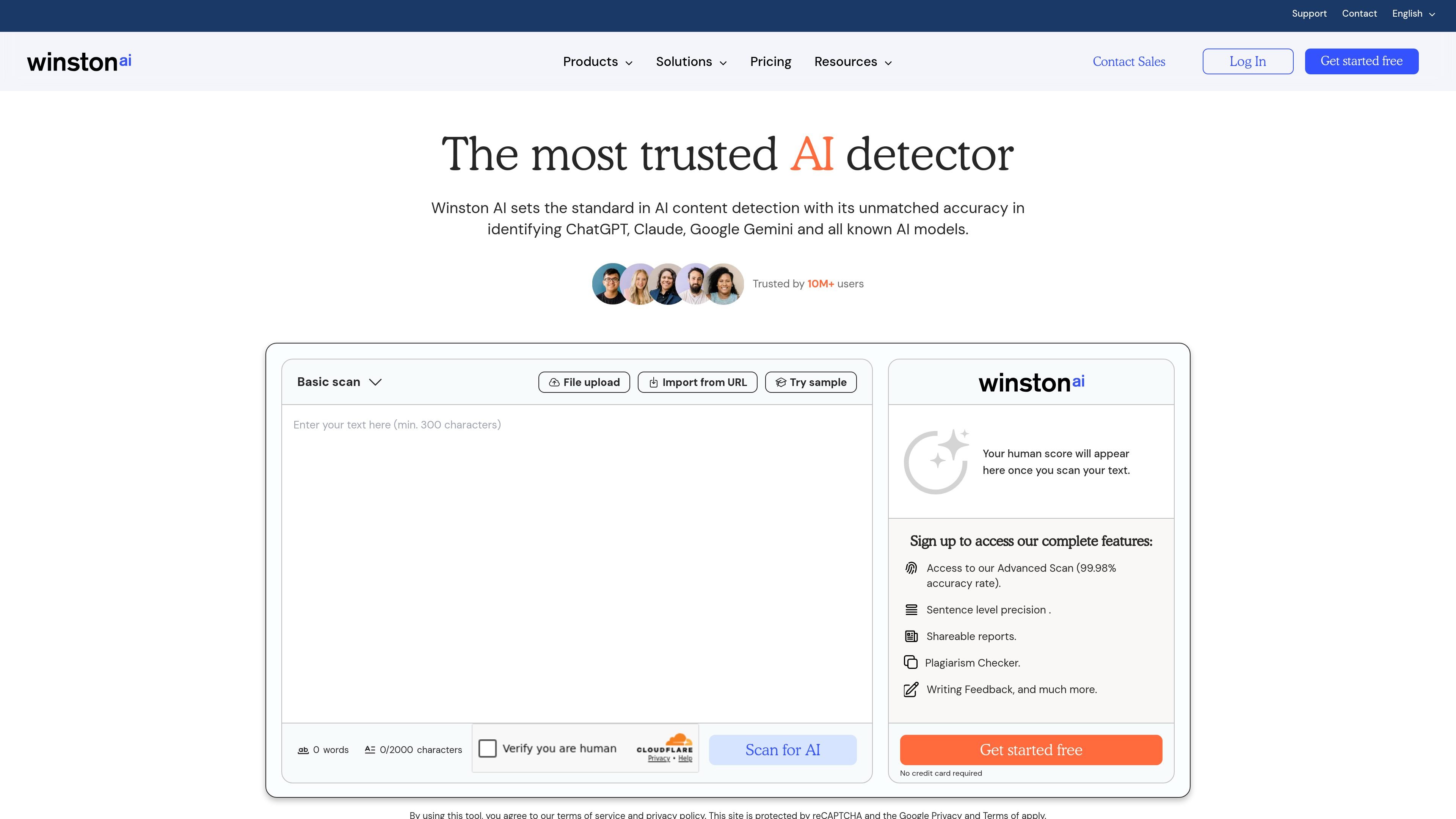
Winston AI is an AI content detection and plagiarism checking platform for evaluating text that may have been generated by tools such as ChatGPT, Claude, Gemini, and other large language models. The site presents it as a web-based detector with both a basic scan and an advanced scan, plus a separate API for teams that want to integrate detection into their own products or research workflows.
The detector experience includes free sign-up, character-limited scanning in the lite version, and additional capabilities such as file upload, import from URL, sentence-level precision, shareable reports, plagiarism checking, and writing feedback. Winston AI also positions its API as private, secure, multilingual, and suitable for business-scale use.
Run a basic scan or an advanced scan depending on how much analysis you need. The advanced scan is described as offering 99.98% accuracy and deeper detection for subtle or mixed AI-generated content.
See sentence-level precision so you can identify which parts of a text raise flags instead of reviewing the whole document as one result.
Generate professional reports that can be shared with teams, clients, or institutions to document results and support review workflows.
Check for plagiarized or improperly sourced content alongside AI-generated text detection to support originality review.
Upload files or import content from a URL after sign-up, which broadens the detector beyond pasted text.
Access writing feedback and other editing support after scanning, giving users a way to refine content after the assessment.
Review student essays or coursework for likely AI-generated passages and use sentence-level results to discuss specific sections rather than making a single pass/fail judgment.
Check submitted articles, blog drafts, or editorial copy for originality before publication, then share reports with editors or clients when documentation is needed.
Combine AI detection with plagiarism checking and writing feedback when revising content so you can identify both machine-generated and improperly sourced text.
Integrate AI detection into a product, research tool, or internal workflow through the API when you need programmatic access rather than a manual web scan.
Test text from files or web pages using the web app when you want to scan longer or externally sourced content after sign-up.
Winston AI is positioned as an AI content detector and plagiarism checker. Its detector page says it can identify content generated by ChatGPT, Claude, Gemini, and other AI systems, and its API page extends that capability to Llama and other major LLMs.
The detector page shows a basic scan and an advanced scan. It also supports file upload and import from URL after sign-up, along with shareable reports, sentence-level precision, plagiarism checking, and writing feedback.
The product pages show a free sign-up flow with no credit card required. The detector limits free use to 2,000 characters and English text in the lite version, while the API page offers 2,500 credits for free to test integrations.
The site describes Winston AI as trusted by institutions, educators, and publishers, and the detector page highlights shareable reports and sentence-level precision, which makes it suitable for review and documentation workflows.
The API page says Winston AI offers AI Detection API, Plagiarism Detector API, Fact Checker API, and AI image detector API, so teams can use it in product or research workflows rather than only through the web app.

Goldfish is an AI memory app for macOS that helps you reply, write, summarize, and continue with context already on your Mac. It stores memory locally and writes in your tone.

ProWritingAid is a writing assistant for storytellers with grammar checking, style editing, paraphrasing, and story analysis in popular writing apps.

SpeakoFlow is a free, open-source desktop voice-to-text app for Windows, macOS, and Linux. Dictate into any app, use Flow, cleanup, translation, and a screen-aware assistant.

Paperpal is an AI tool for academic writing, offering literature reading, language polishing, citations, plagiarism checks, AI detection, and pre-submission review.

Sanota turns spoken memories and interviews into clear written stories for personal storytelling, family history and shared memories, with guided prompts and subscriptions.

Dirac is an AI email assistant for Gmail that prepares a morning brief, prioritizes important threads, and drafts replies in your voice.