
Prompt-based installation
Copy a single prompt into Lovable and the agent builds the supporting pieces it needs, including database tables, edge functions, a dashboard, and a cron schedule.

Lazy Unicorn offers single-prompt AI agents for Lovable projects, covering content, commerce, media, development, and operations. Self-host or use Lazy Cloud.
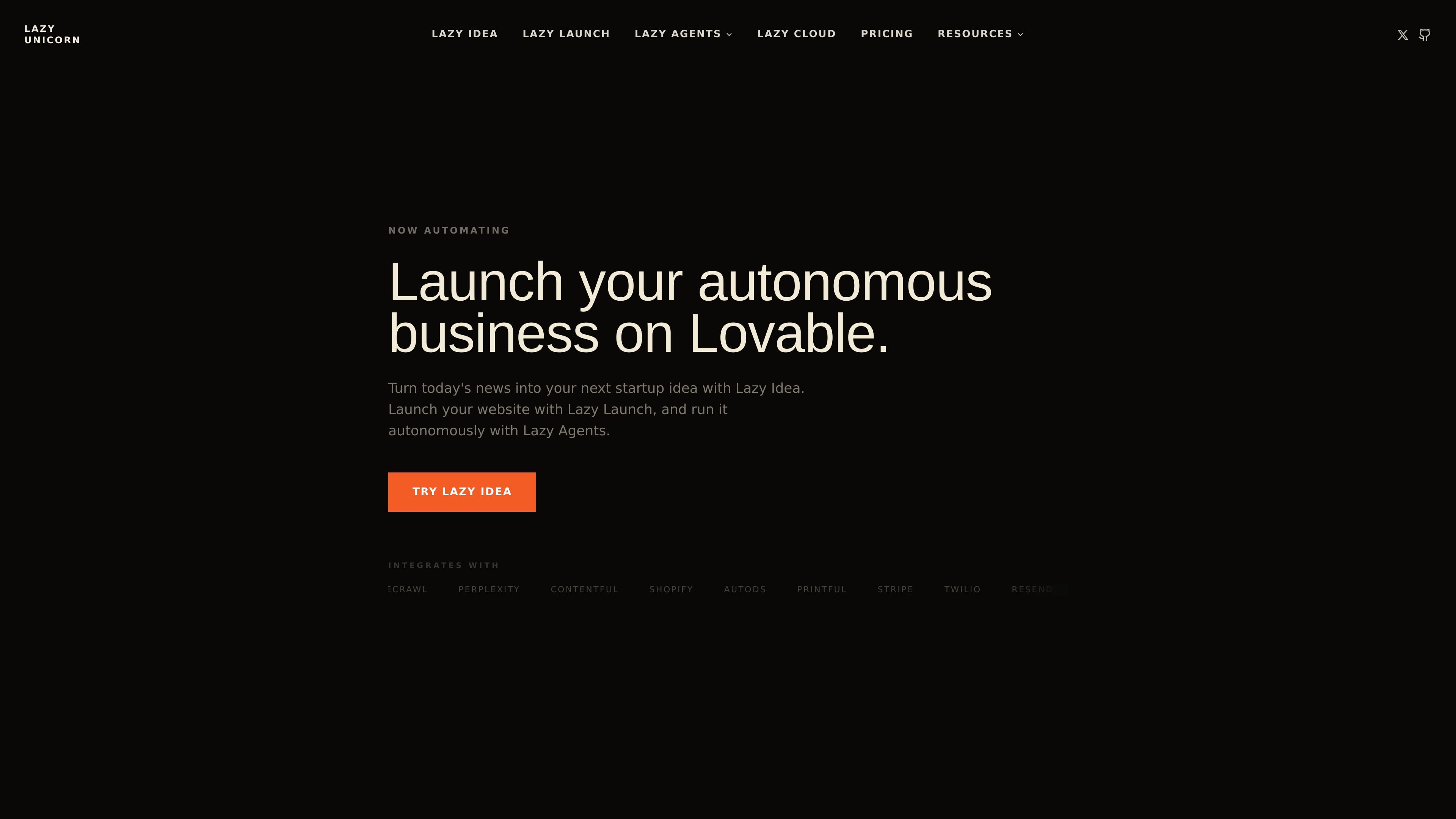
Lazy Unicorn is a library of AI agents for Lovable projects. Each agent is delivered as a single prompt that you paste into a Lovable app, where it can create the database tables, edge functions, UI, and cron schedule it needs to run.
The product is meant to help Lovable sites and apps keep operating after launch. Its agents cover tasks across content, commerce, media, development, and operations, and can run either self-hosted inside your project or through Lazy Cloud for a managed experience.
Copy a single prompt into Lovable and the agent builds the supporting pieces it needs, including database tables, edge functions, a dashboard, and a cron schedule.
Agents are designed to keep working after setup, publishing content, monitoring activity, processing orders, and reporting back without manual operation.
The catalog covers content, commerce, media, developer, and operations workflows, so users can choose agents for tasks such as blog posts, payments, podcasts, changelogs, and alerts.
The site offers self-hosted running for free and a managed Lazy Cloud path with automatic prompt updates, volume API keys, 24/7 monitoring, and daily backups.
Lazy Cloud is described as handling breaking changes and scaling concerns, while self-hosted users manage API keys, updates, and monitoring themselves.
The site lists integrations with services such as Firecrawl, Perplexity, Contentful, Shopify, Stripe, Twilio, Resend, ElevenLabs, Twitch, YouTube, GitHub, GitLab, Linear, Slack, Telegram, Supabase, and Aikido.
Use Lazy Launch to generate a Lovable prompt for a new site, then add supporting agents for blog content, SEO, payments, and related business functions.
Use content agents to research topics, publish blog posts, generate SEO and GEO content, and keep articles grounded in live web data or citations.
Use commerce agents to handle storefronts, one-time payments, subscriptions, email follow-ups, SMS reminders, and abandoned-checkout recovery.
Use media agents to turn written or live content into podcasts, audio narration, stream recaps, video content, and published summaries.
Use dev and ops agents to publish changelogs, summarize commits, monitor errors, open issues or pull requests, and keep the stack observable.
Lazy Unicorn is set up by pasting a single agent prompt into a Lovable project. The docs describe a quick start that can get you running in about 2 minutes, after which the agent creates the needed tables, edge functions, dashboard, and cron schedule.
It is built for Lovable projects. The source describes it as an autonomous layer for Lovable and a library of AI agents that install inside a Lovable project.
Each agent is a self-contained prompt that can install its own database tables, edge functions, UI, and scheduled tasks. Examples on the site include content, commerce, media, developer, and operations agents.
Yes. The site says agents can be run self-hosted for free, where you manage your own API keys, updates, and monitoring. Lazy Cloud is the managed option for hosted execution and monitoring.
The source says all agents are self-hosted in your own Lovable project on the free path. Lazy Cloud is the managed layer and is described as coming soon for hosted, zero-config operation.

Struere turns spreadsheet data into structured operational software with dashboards, alerts, and automations for teams replacing manual spreadsheet workflows.

Goldfish is an AI memory app for macOS that helps you reply, write, summarize, and continue with context already on your Mac. It stores memory locally and writes in your tone.

Lasso is an ecommerce product data platform for enriching catalog records, processing supplier files, generating product content, and tracking competitors. It includes a web app, REST API, SDK, and MCP server.

ArtDeck is a visual reference board app for iPhone, iPad, and Mac. Collect mixed references on one canvas and study them with ToolBox lenses. Offline, optional iCloud sync, one-time purchase.

Codex Plugins bundle reusable skills, app integrations, and MCP servers into workflows you can install in the Codex app or use from Codex CLI.

garden-md is an open-source Node.js CLI that turns meeting transcripts into a local company wiki, linking entities and preserving the original text.