
Rights intelligence feed
Tracks changes from official societies, CMOs, DSPs, copyright offices, and AI-music policy sources when they may affect a registration, claim, or payout.

MARVIS is a music-rights intelligence workspace for artists, managers, publishers, distributors, and rights teams. It monitors publishing, royalty, copyright, DSP, sync, neighboring-rights, and AI-music policy changes while helping organize catalog ownership, splits, registrations, and collection tasks.
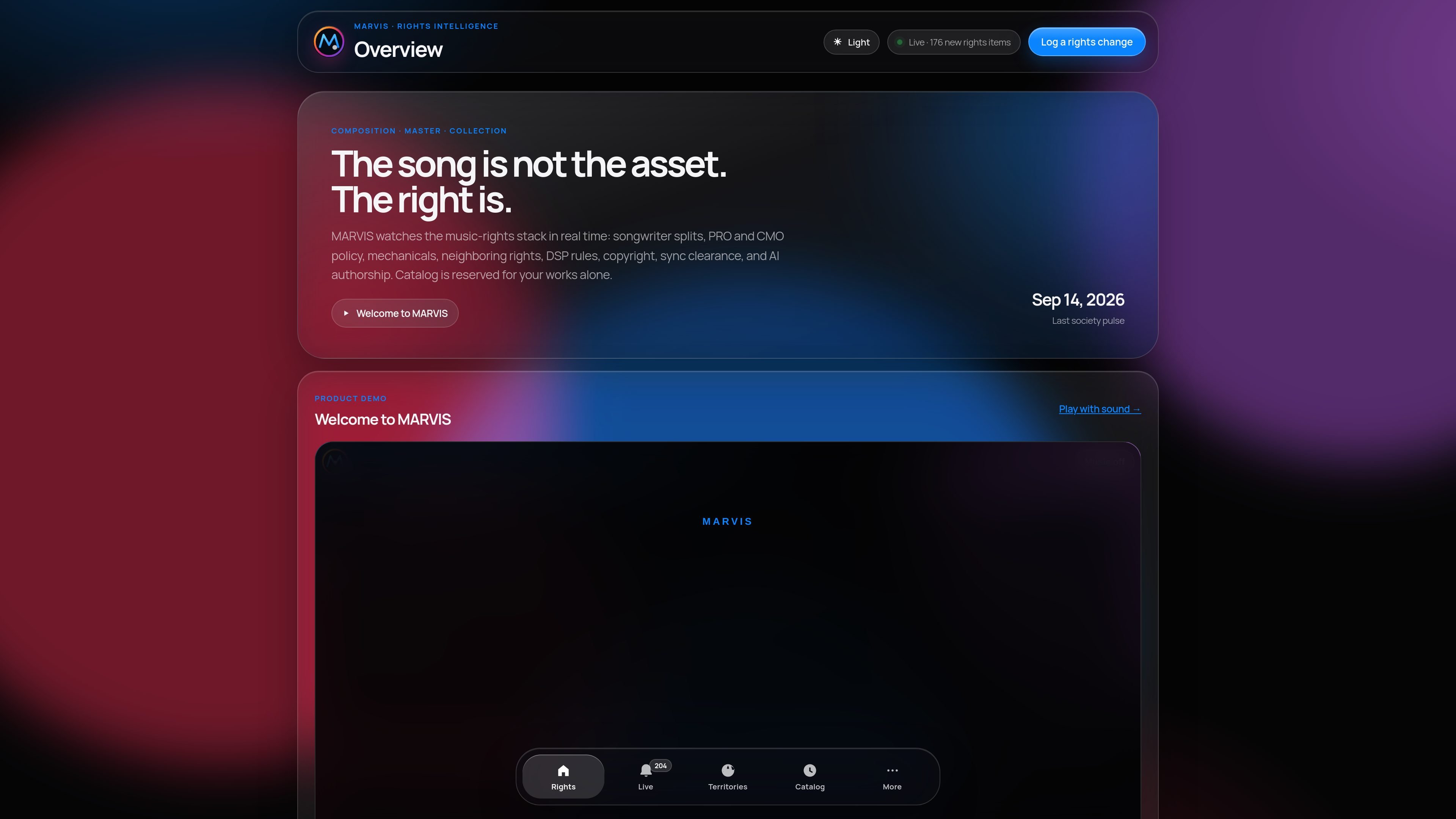
MARVIS (Music Artist Rights Virtual Intelligence) is a music-rights intelligence and catalog-organization product for artists and the people who manage, publish, distribute, or administer their work. It brings publishing, PRO and CMO policy, mechanical and neighboring rights, DSP rules, copyright, sync clearance, and AI-music policy into a single rights-focused workspace.
Its central purpose is to help users distinguish the different rights attached to a song and recording, monitor material changes, and identify unfinished rights actions. The site presents a ninety-day archive of rights intelligence, regional society and collector maps, and catalog-hygiene checks covering ownership, splits, registrations, collection, contracts, and release documentation.
Tracks changes from official societies, CMOs, DSPs, copyright offices, and AI-music policy sources when they may affect a registration, claim, or payout.
Separates songwriter splits, publisher share, performance, mechanicals, IPI numbers, and territorial administrators so composition rights can be documented and registered accurately.
Maps performance, mechanical, neighboring-rights, and AI-policy watchpoints across North America, Europe, Asia-Pacific, Latin America, Africa, and the Middle East.
Follows Spotify, Apple Music, YouTube, TikTok, SoundCloud, and distributor issues involving metadata, artificial streaming or fraud, AI disclosure, artist identity, and monetization.
Provides catalog-hygiene checkpoints for ownership, splits, PRO registrations, mechanical collection, AI usage, contracts, royalty audits, and sync assets.
Frames release and clearance work around the separate requirements for ISRC, ISWC, master and publishing ownership, cue sheets, stems, splits, and approval authority.
Before release, document songwriter splits, ISRC and ISWC identifiers, master and publishing ownership, and the relevant PRO, mechanical, or neighboring-rights administrators.
Use the territory and society view to distinguish who handles performance, mechanical, and neighboring rights in key markets and reduce the risk of assigning one collection route to the wrong right.
Review policy changes affecting metadata, artificial streaming, AI disclosure, artist identity, and monetization before delivering music to Spotify, Apple Music, YouTube, TikTok, or SoundCloud.
Organize ownership records, split confirmations, registrations, contracts, royalty-audit status, and AI authorship evidence while maintaining a view of unresolved catalog tasks.
Assemble composition and master ownership details, cue sheets, stems, splits, and approval authority for a sync request so clearance decisions can be made from documented rights information.
MARVIS monitors rights-related changes across publishing, PRO and CMO policy, mechanicals, neighboring rights, DSP rules, copyright, sync clearance, and AI-music policy. It presents changes that may affect registrations, claims, or payouts.
The site organizes rights information by regions including North America, Europe, Asia-Pacific, Latin America, Africa, and the Middle East. Examples shown include society and collector mappings for Canada, the United States, the United Kingdom, Germany, Japan, and Australia.
The product distinguishes composition and master rights, performance and mechanical royalties, neighboring rights, sync and Content ID, and the roles of societies, DSPs, distributors, managers, producers, and publishers. It is intended to help users map these rights rather than treat them as a single entitlement.
MARVIS includes catalog-hygiene checks such as documenting master and composition ownership, confirming splits, keeping PRO registrations current, mapping mechanical collection, and retaining evidence of human authorship for material AI use.
The site describes a rights feed that rebuilds on a cycle of about fifteen minutes and retains material changes for ninety days. The displayed feed is not necessarily updated to the second.

Goldfish is an AI memory app for macOS that helps you reply, write, summarize, and continue with context already on your Mac. It stores memory locally and writes in your tone.

Lasso is an ecommerce product data platform for enriching catalog records, processing supplier files, generating product content, and tracking competitors. It includes a web app, REST API, SDK, and MCP server.

ArtDeck is a visual reference board app for iPhone, iPad, and Mac. Collect mixed references on one canvas and study them with ToolBox lenses. Offline, optional iCloud sync, one-time purchase.

Struere turns spreadsheet data into structured operational software with dashboards, alerts, and automations for teams replacing manual spreadsheet workflows.

garden-md is an open-source Node.js CLI that turns meeting transcripts into a local company wiki, linking entities and preserving the original text.

Falconer is an AI-powered company brain that keeps internal docs accurate, searchable, and up to date by syncing with GitHub, Slack, and Linear.