
Portable memory across agents
ByteRover is built around persistent memory that carries between agents and tools, so context is not trapped in a single interface.

ByteRover is a local-first memory layer for AI agents that stores markdown-backed knowledge across sessions, with optional cloud sync.
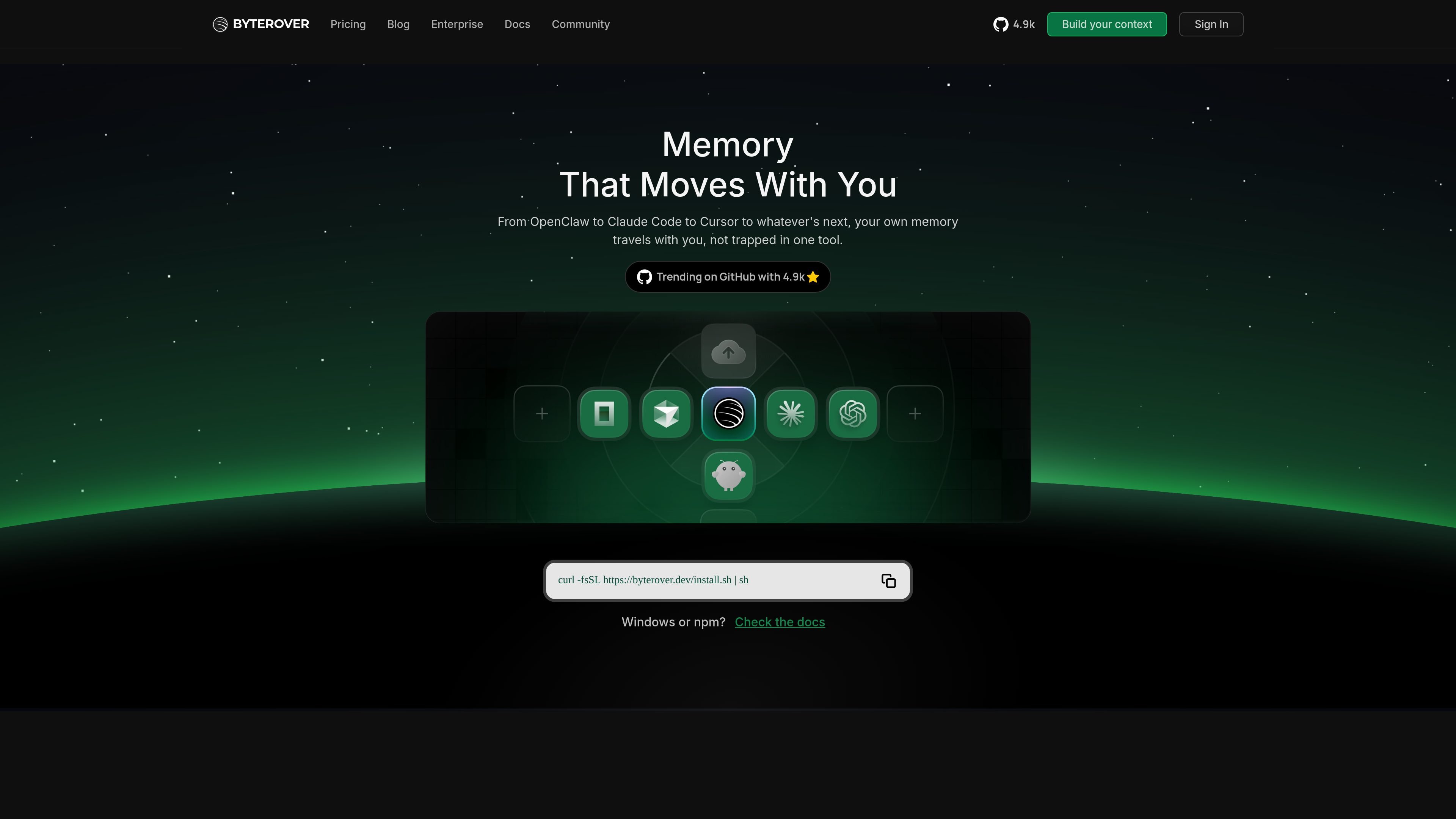
ByteRover is a memory layer for AI agents that stores structured, evolving knowledge so it can be retrieved across sessions and tools. The product is positioned for workflows where an assistant, agent, or team needs durable context instead of starting over each time.
According to the site, ByteRover organizes memory as markdown-backed knowledge in a hierarchical tree and runs locally by default. Users can keep it on their machine, connect it to agents, and optionally push memory to ByteRover Cloud when they want portability or team access.
ByteRover is built around persistent memory that carries between agents and tools, so context is not trapped in a single interface.
The product curates knowledge into a hierarchical tree rather than treating memory as a flat list of notes or embeddings alone.
The home page and architecture post describe a local-first workflow where memory runs on your machine by default and can be pushed to cloud storage when needed.
The retrieval system is described as a tiered file-search pipeline that moves from fuzzy text matching to deeper LLM-driven search for higher precision.
ByteRover accepts markdown-backed context and can organize existing text files such as MEMORY.md or other project notes into a queryable structure.
The site says ByteRover can work with your own LLM provider using an API key, so teams can keep their existing model stack.
Use ByteRover when you want an assistant to remember preferences, prior decisions, and ongoing work across separate conversations or tools instead of rebuilding context every time.
Use the local-first workflow when you want to keep memory on your own machine and only sync to cloud storage when portability or sharing becomes necessary.
Use the markdown-backed curation flow when you already have notes or memory files and want them organized into a queryable structure without abandoning your existing text-based workflow.
Use the product in agent setups such as OpenClaw, Claude Code, or Cursor when the goal is to share memory across multiple agents or tools.
Use the higher-tier plans when you need team access, access controls, or enterprise operating requirements such as SSO/SAML, RBAC, data residency, or audit logs.
ByteRover is designed to work locally by default. The home page says it runs on your machine with no account, no cloud, and no telemetry, and that you can push memory to ByteRover’s cloud only when you want to.
The source shows a Free plan, a Pro plan for individual power users, a Team plan for collaboration, and an Enterprise plan for custom needs. The pricing page also notes features such as cloud sync, context management, SSO/SAML, SOC 2, RBAC, on-prem gateway, and audit logs on higher tiers.
The home page says ByteRover can be used with any model or provider and that you can bring your own LLM using an API key. The source also mentions use with OpenClaw, Claude Code, and Cursor.
The product stores memory as markdown-backed, structured context organized into a hierarchical tree, and the architecture post describes a domain/topic/subtopic structure with context.md files and standalone entries.

garden-md is an open-source Node.js CLI that turns meeting transcripts into a local company wiki, linking entities and preserving the original text.

Osaurus is a native macOS AI agent platform for Apple Silicon that keeps models and data on your Mac, with optional ChatGPT, Claude, or Gemini access.

Goldfish is an AI memory app for macOS that helps you reply, write, summarize, and continue with context already on your Mac. It stores memory locally and writes in your tone.

Lasso is an ecommerce product data platform for enriching catalog records, processing supplier files, generating product content, and tracking competitors. It includes a web app, REST API, SDK, and MCP server.

Codex Plugins bundle reusable skills, app integrations, and MCP servers into workflows you can install in the Codex app or use from Codex CLI.

Struere turns spreadsheet data into structured operational software with dashboards, alerts, and automations for teams replacing manual spreadsheet workflows.